
 Skip to content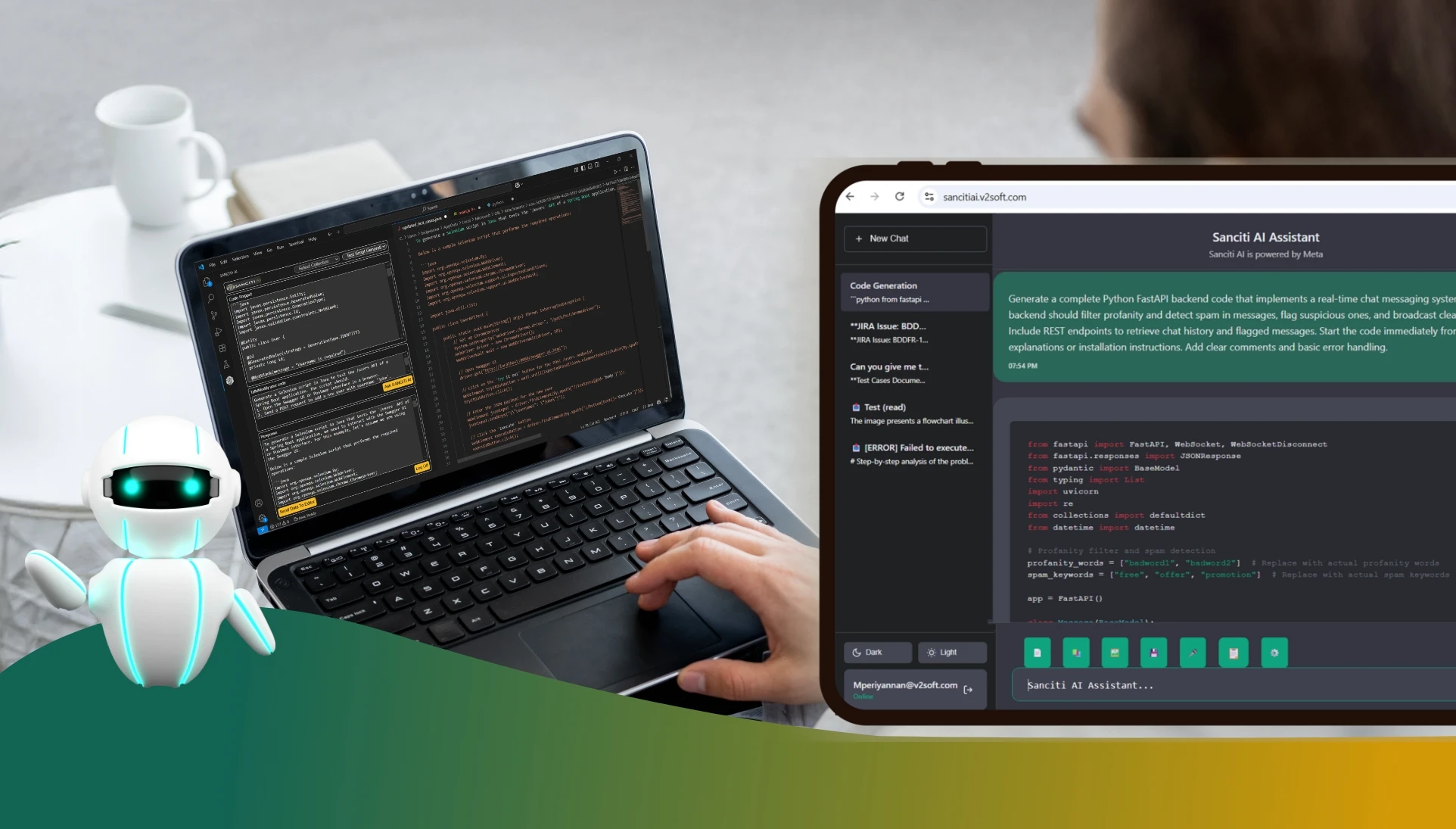
Software delivery has entered a turning point. Generative models and copilots have proven useful for individual developers and small teams, but they do not solve the harder enterprise problems of scale, governance, compliance and repeatable outcomes. What large organizations need is not another suggestion engine – they need orchestration: a way to coordinate work across requirements, development, testing, and deployment while keeping security and traceability front and center.
That orchestration is what Agentic AI delivers. Agentic AI moves the industry from isolated prompt-response interactions to a coordinated, outcome-driven approach that is purpose-built for enterprise software delivery. When paired with a platform designed to operationalize it – for example, Sanciti AI – Agentic AI becomes a practical path to faster releases, lower costs, and measurable improvement in software quality.
What Agentic AI is, why it matters now, how it works in real enterprise environments, and how Sanciti AI implements Agentic AI for the SDLC. It also outlines concrete use cases, expected outcomes, and practical next steps for teams considering a move beyond Gen AI copilots.
At a glance, Agentic AI describes systems that coordinate autonomous, task-oriented components to deliver an end-to-end outcome. Unlike single-model Gen AI tools that answer individual prompts or generate code snippets, Agentic AI is architected to:

Execute Workflows Rather Than Single Commands

Maintain Contextual State Across Steps

Apply Governance And Policy At Scale

Tie Outputs Back To Traceable Business Requirements And Tests
Put simply, Agentic AI acts as a conductor for the SDLC. It continuously aligns tasks – requirements extraction, code generation or refactoring, test generation, vulnerability scanning, and deployment validation – with enterprise rules and objectives. This approach makes it possible to automate complex processes while ensuring safety, compliance, and auditability.
Because Agentic AI coordinates actions across systems and teams, it is often referred to in enterprise discussions as Agentic AI For SDLC Platform or Agentic AI for Enterprise when the focus is on governed, large-scale adoption. Agentic GEN AI is a related concept, emphasizing generative model components inside an agentic architecture.
All three phrases are useful: the generative models provide capabilities, but the agentic framework supplies the controls, orchestration, and outcomes.
Learn more about the foundation of Agentic AI and how it powers enterprise automation in our blog:
What Is Agentic AI — A Complete Guide for Enterprise Software Teams
Over the last two years, many organizations piloted Gen AI copilots to help with code completion, documentation, or templated test generation. Those pilots provided quick wins, but they also revealed limitations:
Copilots help individuals. They do not coordinate thousands of microservices, CI/CD pipelines, and cross-team release processes. Enterprises need systems that manage complexity at scale.
Industry regulations (HIPAA, NIST, OWASP, accessibility rules such as ADA) require traceable controls. Random code suggestions without traceability or enforced policies create risk, not relief.
Business leaders ask for impact: faster time-to-market, lower QA budgets, fewer production defects, and predictable release cadence. Copilots rarely produce measurable enterprise-level KPIs.
One-off prompts don’t scale into repeatable processes across portfolios. Enterprises require playbooks, templates, and enforcement that ensure each change follows the same secure path.
Sanciti’s Agentic AI for Enterprise addresses these gaps. It is designed for scale, repeatability, and governance. Where Gen AI supplies capabilities, Agentic AI supplies the architecture that integrates those capabilities into the software lifecycle. The result: secure automation that leaders can trust and measure.
Agentic AI is an architecture, not a single algorithm. It combines modular components (which we often call “agents” in architectural diagrams) that each handle specific responsibilities and communicate to achieve a larger goal. To make this concrete, here’s an enterprise implementation pattern that many organizations adopt – and which Sanciti AI operationalizes as part of its Agentic AI For SDLC Platform.
The First Step Is Discovery. The Platform Ingests Repositories, Build Scripts, CI/CD Definitions, And Runtime Configuration. It Builds A Dependency Graph That Surfaces Module Boundaries, Third-Party Libraries, And Runtime Characteristics.
Why This Matters: Discovery Uncovers Hidden Coupling And Risk Before Any Change Is Attempted. Agentic AI Uses That Context To Make Safer Recommendations.
Next, The System Analyzes Code For Deprecated Apis, Cves, And Compliance Gaps. It Also Reverse-Engineers Requirements And Behavior Where Documentation Is Missing – A Capability Often Labeled As Requirements Generation (RGEN).
Why This Matters: Teams Gain A Single Source Of Truth For What The System Actually Does, Which Enables Precise Impact Analysis And Reduces Surprises During Migration Or Refactor.
Agentic AI Proposes Safe Change Sets: Conservative Refactors, Dependency Upgrades, Or Migration Plans. These Proposals Include The Expected Impact, The Lists Of Files Changed, And Suggested Tests – All Aligned To A Traceable Requirement.
Why This Matters: Proposals Are Machine-Assisted But Human-Reviewable, Giving Engineering Teams Control Over Changes While Reducing Manual Analysis Work.
When Approved, The Platform Can Apply Automated Refactors And Generate Unit, Integration, And Contract Tests (Testai). Tests Are Executed In CI To Validate Behavior. Static And Dynamic Analysis (CVAM-Style Checks) Run Continuously To Catch Regressions Or Security Issues Early. Why This Matters: Implementation And Validation Are Merged, Enabling Safe Automation With Rollback Plans And Audit Trails.
Before A Release, Agentic AI Validates Release Artifacts Against Policy: Dependency Scannings, Sboms, Accessibility Checks, And Environment Configuration. Only Artifacts That Meet The Enterprise Policy Are Promoted.
Why This Matters: Releases Are Consistent, Auditable, And Compliant By Design.
Post-deploy, the platform monitors logs, correlates incidents, and suggests fixes, feeding them back into the planning backlog (PSAM-style support). This closes the loop and provides measurable operational improvements.
Why this matters: operations and development become a continuous, automated loop – enabling faster resolution and fewer repeated failures.
To explore how teams build, test, and deploy using this exact workflow, read our blog:
How to Create Your Own Software with Agentic AI — Building Smarter, Not Harder
Sanciti AI implements the Agentic AI pattern as a platform that integrates discovery, test automation, security checks, and production support. Below are the practical modules and how they map to the Agentic AI workflow:

(REQUIREMENTS GENERATION)
Converts code and docs into structured requirements and testable use cases. This clarifies scope and traceability before changes begin. (Internal link: /use-cases/requirements-generation)

(AUTOMATED TESTING & ANALYSIS)
Generates unit and functional tests, creates regression suites, and runs static/dynamic analysis. This reduces QA effort and improves coverage. (Internal link: /products/sanciti-testai)

(CODE VULNERABILITY ASSESSMENT & MITIGATION)
Performs vulnerability scanning during development and suggests mitigation patterns to fix high-priority risks before they reach production.

(PRODUCTION SUPPORT & MONITORING)
Analyzes logs and tickets, identifies recurring issues, and suggests preventive changes — enabling ongoing reliability improvements and faster incident resolution.
By combining these modules, Sanciti AI acts as an Agentic AI For SDLC Platform – not only enabling automation but enforcing the governance and compliance enterprises require. Internal links to product and solution pages should be placed within the live site content to direct readers to demo requests and deeper technical documentation.
Below are real-world scenarios where Agentic SI shifts outcomes measurably.
Many Enterprises Face The Trade-Off Between Risky Rewrites And Fragile Band-Aid Updates. Agentic AI Enables Incremental Modernization: Identify Compatible Refactor Paths, Auto-Generate Tests, And Cut Migration Risk. Result: Modern Runtimes And Frameworks With Preserved Business Logic And Lower Operational Risk.

By Generating Tests Automatically And Running Static/Dynamic Analysis Early, Agentic AI Reduces Manual Test Authoring And Rework. Organizations Report Substantial QA Budget Reductions And Faster Sign-Off Cycles.

Embedding Vulnerability Scanning And Policy Checks Into The Workflow Prevents Common Issues From Slipping Into Production. Agentic AI Integrates OWASP And NIST-Aligned Checks Into Release Gates.

Agentic AI Codifies Migration Patterns Into Reusable Playbooks (E.G., Struts→spring Boot, Java 8→17/24). These Patterns Speed Future Migrations, Reducing Time-To-Value Across Portfolios.

Post-Deploy, The Platform Analyzes Incident Patterns And Suggests Code Or Configuration Changes To Prevent Recurrences – Reducing MTTR And Building Operational Knowledge Into The System.
Enterprises across industries are modernizing faster with Sanciti AI — delivering agility, compliance, and automation across every business function.
Agentic AI projects that include automation in testing, analysis, and deployment generally show measurable improvements within pilot cycles:

(through test generation and automation).

depending on pipeline bottlenecks and how extensible the platform is to your existing CI/CD.

due to early vulnerability detection and improved test coverage.

for feature increments that are covered by automated processes.

as automated checks catch more issues earlier.
These results are powered by Sanciti AI’s Agentic Gen AI platform, enabling faster time-to-market with full governance and policy-driven automation.
It helps to see the difference in table form:
| Capability | Gen AI (copilot) | Agentic AI (orchestrated) |
|---|---|---|
|
Scope |
Individual prompts or code snippets |
End-to-end workflows |
|
Context |
Short-lived, per-prompt |
Persistent across tasks and time |
|
Governance |
Little or none |
Policy-driven, auditable |
|
Traceability |
Limited |
Traceability from requirement to release |
|
Outcome focus |
Developer productivity |
Business KPIs (MTTR, QA cost, release velocity) |
|
Scale |
Individual/team |
Portfolio/enterprise |
While Gen AI is often a valuable component inside an agentic architecture (generative models still power code synthesis and natural language understanding), organizations that stop at copilots miss the orchestration and governance layer that creates enterprise-level value.
See how enterprises are choosing Agentic AI over traditional copilots for real transformation in our blog:
Why Agentic AI Is the Enterprise Alternative to Copilot-Style AI
If you’re evaluating the technology, consider this staged approach:

Ingest representative repositories, build a dependency graph, and create a risk/compatibility map. This gives a baseline for scope and effort.

Pick a representative app or service. Implement the Agentic AI workflow: discovery → proposals → automated refactors and tests → controlled rollout. Measure the KPIs (cycle time, QA effort, defects).

Codify the playbooks from the pilot. Extend the platform patterns to adjacent applications and teams. Establish an internal COE for Agentic AI best practices.

Maintain the feedback loop with production analysis, continuous test updates, and policy refinement.
This staged rollout reduces risk and delivers measurable proof points before broad adoption.
Every enterprise can begin its journey with Sanciti AI’s Agentic AI Platform, designed for scalable, compliant automation from day one.

Agentic AI refers to systems that orchestrate autonomous, task-focused components to solve broader problems. In the SDLC context, it coordinates code changes, tests, security checks, and releases to achieve a governed outcome.
Gen AI provides capabilities such as text or code generation. Agentic AI uses those capabilities inside managed workflows, adding traceability, governance, and orchestration to produce enterprise-ready outcomes.
Yes – if implemented with compliance in mind. Agentic AI platforms like Sanciti AI incorporate policies and checks aligned to HIPAA, OWASP, NIST, and accessibility requirements to ensure releases meet regulatory needs.
Agentic GEN AI emphasizes the generative model components inside an agentic architecture. Think of it as the “creative” part (generation) working under the “conductor” (agentic orchestration).
Pilot programs often show measurable ROI within the pilot window (6–12 weeks) for QA savings, faster releases, and reduced incident rates. The exact timeframe depends on the starting state of pipelines and the scope of the pilot.
Access to repositories and CI/CD definitions, a representative application to pilot, named stakeholders for parity and rollout decisions, and basic SRE/DevOps capabilities for integration.


Generative models changed expectations. They made it clear that AI could help developers. Agentic AI takes the next, necessary step - combining generative capabilities with orchestration, governance, and measurable outcomes. For enterprises, that difference is everything: it brings predictability to modernization, security to delivery, and measurable savings to operations.
If your organization is evaluating modernization options, a short pilot with an Agentic AI For SDLC Platform can prove whether your processes and applications are ready for broader automation. To see how Agentic AI works in practice and how Sanciti AI operationalizes these patterns.

Generative models changed expectations. They made it clear that AI could help developers. Agentic AI takes the next, necessary step — combining generative capabilities with orchestration, governance, and measurable outcomes. For enterprises, that difference is everything: it brings predictability to modernization, security to delivery, and measurable savings to operations. If your organization is evaluating modernization options, a short pilot with an Agentic AI For SDLC Platform can prove whether your processes and applications are ready for broader automation. To see how Agentic AI works in practice and how Sanciti AI operationalizes these patterns,


Sanciti Al requiresthe contact information you provide to us to contact you about our products and services. You may unsubscribe from these communications at any time. For information on how to unsubscribe, as well as our privacy practices and commitment to protecting your privacy, please review our Privacy Policy.
See how Sanciti Al can transform your App Dev & Testing
SancitiAl is the leading generative Al framework that incorporates code generation, testing automation, document generation, reverse engineering, with flexibility and scalability.
This leading Gen-Al framework is smarter, faster and more agile than competitors.
Why teams choose SancitiAl:

Full-service framework including:
Generates Requirements, Use cases, from code base.
Generates Automation and Performance scripts.
Code vulnerability assessment & Mitigation.
Production support & maintenance, Ticket analysis & reporting, Log monitoring analysis & reporting.
AI-Powered Legacy Modernization That
Accelerates, Secures, and Scales